
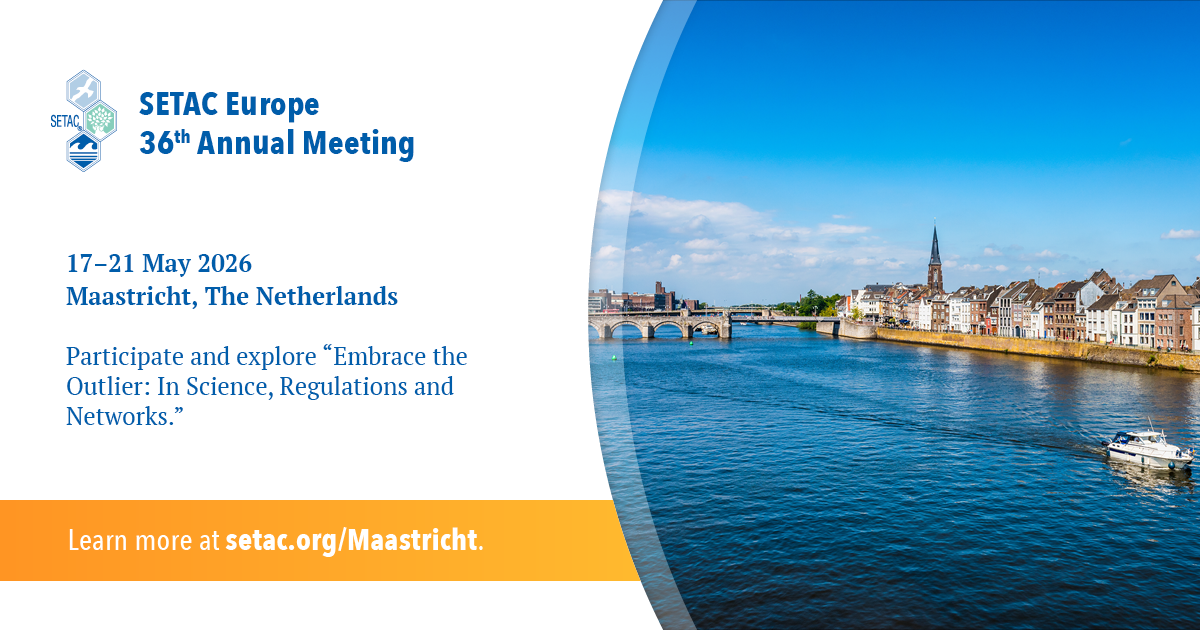
Our team at Vitis Regulatory was pleased to attend the SETAC Europe 36th Annual Meeting in Maastricht, where scientists, regulators and industry came together once again to share and discuss the latest advances in environmental science. The meeting sparked inspiring conversations and reinforced the power of collaboration in driving the science forward.
During the meeting, our team were proud to contribute to the programme in a number of ways. For more information (or to download our poster presentations), please see our previous posts here:
· https://www.vitisregulatory.com/vitis-news/vitis-regulatory-at-setac-europe-36th-annual-meeting-2026
Our key reflections on the event are as follows:
Environmental risk assessment is continuing to evolve – Momentum behind modernised methods, predictive approaches (including AI), NAMs and the integration of diverse evidence streams into environmental risk assessment was highlighted. As the science continues to evolve, can regulatory frameworks such as REACH adapt quickly enough to realise the potential of these advances to support scientifically robust decision-making?
The gap between academic research, industry activities and regulatory topics is getting smaller - Academic research is increasingly addressing regulatory requirements. But there is still a long way to go.
International and interdisciplinary collaboration was a defining feature of the meeting – Evident in both the research presented and the interest groups, where scientists from diverse disciplines shared perspectives and connected.
Mobility and PMT/vPvM are continuing to gain momentum as a key area of focus – There were many discussions on appropriate criteria for mobility assessment, applicability of standard test methodologies and practical approaches for identifying and regulating mobile substance in the environment. Significant progress is expected in these discussions over the coming years, especially if mobility is formally integrated into REACH and other regulatory frameworks.
Endocrine Disruptors are taking an important role in the chemical hazard assessment stage in the EU and elsewhere - The conference theme of ‘Embrace the outlier’ prompts the question how do we make the best of unique situations? This seems particularly relevant in the realm of ED assessment, and it was refreshing to see how many presentations were devoted to this subject throughout the week. There is still a lot of work to do, both fundamental and applied sciences are needed. However, much progress has been made. Nowadays we are looking deeper at the consequences over less traditional mechanisms (non-EATS) using newer, emerging techniques (NAMs).
There was a clear commitment to research and innovation on environmental exposure, from industry, academia and expert consultants – This was indicated by a full day of presentations and posters on advances in exposure modelling - closing the gap between scientific innovation and regulatory relevance. Despite the current regulatory focus on hazards in Europe, it is clear that understanding the environmental fate and distribution of substances remains of critical importance to understanding risk and therefore the effective risk management of chemicals. Adaptations of existing models and development of specific models to understand environmental exposure have been applied in the context of cosmetics, chemical mixtures and for particles like microplastics.
Thank you to everyone who connected with us in Maastricht. If you would like to explore any of these topics further, please reach out. We would love to continue the conversations - info@vitisregulatory.com.